
Your MSP Is Delivering. Your Clients Don’t Know It.
Why the Biggest Scaling Gap in Managed Services Has Nothing to Do with Technicians – and Everything to Do with How You Communicate Value
The Problem
Most MSP owners reading this are running good operations. Tickets are getting resolved. Systems are monitored. Response times are respectable. The technical work is solid. And yet, at renewal time, clients leave. Or they do not expand. Or they respond to a competitor’s pitch because that competitor showed up with a polished deck and a clear story about what the last 12 months looked like in dollar terms.
The gap is almost never technical. It is communicative. The work is being done but it is not being seen. The value is real but it is not being articulated. And the brutal irony is that this is not a problem that more technicians can solve. It is a customer success problem – and it is the single most common reason MSPs that are technically excellent still fail to grow the way they should.
The challenge is that building a formal customer success function is expensive. A dedicated customer success manager in the US earns between $59,000 and $165,000 per year according to ZipRecruiter, with the Glassdoor average sitting at $74,500. For most small and mid-sized MSPs, that is a hire they cannot justify – and so the customer success function either falls to the owner, gets distributed unevenly across the technical team, or simply does not happen at all.
How the Gap Shows Up Day to Day
The absence of a structured customer success function is not always visible immediately. It tends to build quietly, and by the time it shows up in your numbers, it has been costing you for months.
Clients do not know what they are getting. According to Humanize IT, most of an MSP’s client decision-makers do not actively participate in day-to-day IT operations and are often completely unaware of the work being done on their behalf. The person who signs the renewal is often not the person who watches the tickets. If your value story is buried in your helpdesk platform, it is effectively invisible to the people making the decision to stay or leave.
The “no news is good news” assumption is costing you renewals. Many MSPs operate on the basis that a quiet client is a happy one. ScalePad’s 2025 MSP Business Trends Report tells a different story: nearly a third of MSPs – 36% – have client retention rates below 50%, meaning they are replacing more than half their client base every year. A significant portion of that churn comes from accounts that never raised concerns.
QBRs do not happen consistently – or at all. Quarterly business reviews are widely recognized as one of the highest-leverage activities an MSP can do for retention and expansion. JumpCloud’s QBR guide notes that regular business reviews are essential for demonstrating value, aligning on strategy, and keeping clients engaged between contracts. But preparing a meaningful QBR requires pulling data from multiple systems, synthesizing it into a coherent narrative, and packaging it in a way that resonates with a business owner, not an IT professional. Without a dedicated person to own that process, QBRs get deprioritized or reduced to a quick call with a few screenshots.
Expansion revenue is being left on the table. Lifecycle Insights’ research, published via NinjaOne, shows that QBRs done strategically are not just retention tools – they are sales tools, identifying technology lifecycle opportunities and expansion needs that clients would not surface on their own. MSPs without a consistent review cadence are systematically missing those conversations.
The owner absorbs the burden. When there is no one formally responsible for customer success, the responsibility defaults to whoever has bandwidth – which is usually no one, or the owner at 9pm. This is a hidden tax on leadership time that compounds as the client base grows.
Consider this scenario, which plays out in MSPs everywhere: a technically strong team of eight manages 30 clients. Every client is getting great service. But the last formal business review happened eight months ago for their biggest account, and the remaining 29 clients have had nothing structured in over a year. Two clients are up for renewal in 60 days. Neither has had a touchpoint in months. The team is too busy firefighting to prepare a report, so the renewal conversation happens cold – and one of them decides to “take a meeting” with a competing provider who reached out last week.

The Solution
The fix is not to hire a customer success manager. Not yet, and possibly not ever if the right systems are in place. The fix is to build a customer success function into how your MSP operates – one that runs consistently, surfaces the right information at the right time, and produces the client-facing output that makes value impossible to ignore.
ScalePad’s 2025 research is direct on this point: the differentiators shared by top-earning MSPs include formal customer success programs, client-facing technology roadmaps, renewal strategies, monthly client reviews, and regular sharing of metrics and lifecycle data with clients. These are not expensive activities in isolation. What makes them expensive is the manual labor of doing them consistently across every account, every quarter, without a dedicated owner.
Despite 74% of MSPs claiming to have a customer success program, ScalePad found that most are missing critical elements: dedicated account managers, vCIO or vCISO services, client-facing roadmaps, or monthly review cadences. In other words, most MSPs have the intention of customer success but not the infrastructure to deliver it at scale.
The structural answer is to separate the intelligence and communication layer of customer success from the human judgment layer. A system can monitor client health signals, aggregate service data, identify which accounts need attention, and generate value narratives automatically. What it cannot replace is the actual relationship conversation, the QBR itself, the renewal negotiation, the strategic advisory moment. That still requires a human. But the human only needs to show up when the system has already done the preparation.
This is exactly what Prioriwise is built to provide. For MSPs that cannot justify a full-time customer success hire, Prioriwise acts as the intelligence and reporting engine that makes a systematic CS function possible with the team you already have. It continuously analyzes your client data to surface account health signals – identifying which clients are engaged, which are drifting, and which need proactive attention before the next renewal cycle. It converts that raw operational data into clear, client-facing value narratives so that when your team does sit down with a client, the story is already prepared.
The result is that your owner stops being the de facto account manager. Your technicians stop getting pulled into relationship conversations they are not equipped for. And your clients get consistent, meaningful communication about the value you are delivering – not because you hired someone to do it, but because the process runs on its own.
The business case for investing in this is straightforward. Increasing client retention by just 5% can increase MSP profits by 25% to 95%, according to Axcient’s QBR Handbook for MSPs. The probability of selling additional services to an existing satisfied client is 14 times higher than selling to a new one. The revenue impact of a functioning customer success layer is not marginal. It is structural.
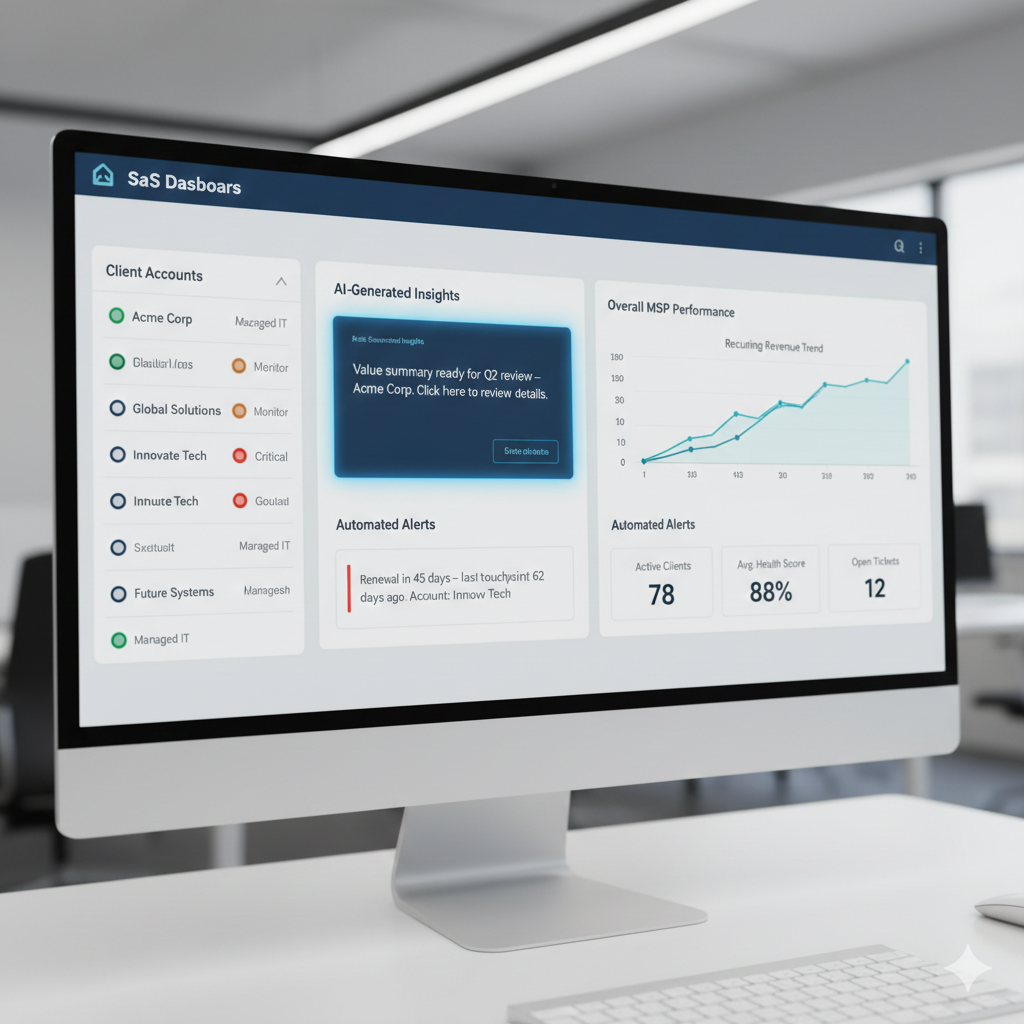
What Changes When the CS Layer Runs Systematically
When customer success is no longer dependent on someone having enough bandwidth to remember it, the whole client relationship dynamic shifts.
Renewals stop being reactive. Instead of entering a renewal conversation hoping the client is satisfied, you enter it knowing their health score, knowing the last touchpoint was recent, and knowing the value story is current and documented. The client has been seeing their ROI in regular reports throughout the year. The renewal is a formality, not a negotiation from zero.
Expansion conversations become natural. When your team is sitting down with clients on a regular cadence – with data prepared and a technology roadmap ready – the lifecycle replacement opportunities and service expansion moments that NinjaOne’s Lifecycle Insights research identifies become visible and actionable. Those conversations do not happen with clients you have not spoken to in six months.
Your owner gets time back. This is an underestimated outcome. When the client communication layer runs on its own, leadership attention can go toward growth, strategy, and new business rather than being consumed by the relationship maintenance that no one else is doing.
And critically, the business becomes more scalable. Each new client you add does not require a proportional increase in relationship management effort. The system handles the monitoring, the reporting, and the flagging. Your team handles the conversations that matter.
Final Thoughts
At Prioriwise, we built our platform around a belief that is simple but easy to overlook: great IT service providers should not lose clients because they were too busy delivering to communicate. The work is being done. The value is real. The gap is almost always in the visibility layer – the systems and processes that translate operational excellence into a story a client can understand, remember, and act on at renewal time.
Most of the MSP industry’s conversation about scaling focuses on technical capacity – RMM tools, automation, endpoint ratios. Those matter. But the client relationship side of the business scales differently, and it scales on communication, data, and consistency rather than headcount. That is the gap Prioriwise is built to close.
We are committed to building the tools that make a world-class customer success function accessible to every MSP, not just the ones large enough to afford a dedicated team. Because the MSPs that retain clients, grow accounts, and build genuinely durable businesses are not necessarily the most technically sophisticated. They are the ones whose clients always know exactly what they are getting, and why it is worth every dollar of their contract.
Key Takeaways
These principles apply to any MSP regardless of team size or current tooling:
Value delivered in silence is value at risk. ScalePad’s 2025 data shows 36% of MSPs have retention rates below 50%, a figure that correlates directly with the absence of consistent client communication. If your clients cannot articulate what you do for them, they are vulnerable to any competitor who can tell a clearer story.
Building a strong customer success function starts with the right systems. The most time-intensive parts of CS are monitoring account health, aggregating service data, generating reports, and identifying at-risk accounts, which can run systematically, freeing your team to focus on what matters most: the real conversations, the strategic advice, and the relationships that no system can replace.
QBRs are both a retention and a revenue tool. Lifecycle Insights research shows that consistent, data-driven business reviews generate expansion revenue and project work beyond their role in retention. An MSP that skips or shortcuts QBRs is not just risking churn – it is leaving upsell and cross-sell revenue on the table every quarter.
A 5% improvement in retention compounds significantly. Axcient’s research shows that a 5% increase in client retention can translate to profit growth of 25% to 95%. The return on investment in customer success infrastructure – whether human or automated – is not marginal. It is one of the highest-leverage moves an MSP can make.
This blog was researched and written with the assistance of AI. All data points have been verified and linked to their original sources.
Ready to stop reacting and start predicting?
See how Prioriwise turns your delivery data into a live Relationship Health Score for every client.
Get Started