
Why Your Best MSP Clients Leave Without Warning
The “Silent Churn” Problem Nobody Talks About and How to Stop It Before It Costs You a Renewal
The Problem
It was not a bad service ticket. It was not a missed SLA. There was no angry email, no difficult quarterly business review, no red flags at all. And then, at renewal time, the client simply said: “We have decided to go in a different direction.”
If you have run an MSP for more than a couple of years, you have probably felt that gut-punch. What makes it worse is not just the lost revenue. It is the confusion. You did everything right. Tickets were resolved on time. Uptime was excellent. The client was, as far as you could tell, perfectly satisfied. The painful truth is that “satisfied” and “committed to renewing” are not the same thing, and the gap between them is where most MSP churn quietly lives.
Silent churn does not announce itself. It does not come with complaints or escalations. It comes with polite emails, delayed responses, and a growing sense on the client’s side that what you do has become invisible – background noise rather than business value. According to research compiled by 1st Financial Training Services, 96% of unhappy customers never complain. 91% of them simply leave and never come back. By the time a client says it out loud, the decision has already been made weeks or months earlier.
How It Affects You
The scale of the problem is significant. According to Xurrent, the average annual customer churn rate across global MSPs sits at 12%. The Technology and Services Industry Association Managed Services Benchmark puts average MSP retention at 90%, but notes that more than half of MSPs report figures below that number, with some reporting retention as low as 70%. In 2025, managed IT services firms average an 83% retention rate, meaning roughly 1 in 6 clients does not renew each year.
Here is how that plays out across an MSP that is not watching for the warning signs:
You lose accounts with no opportunity to course-correct. Clients who complain give you friction, but friction gives you information. Silent churn provides no signal, no chance to address concerns, and no window to act before the relationship is gone. Research by Lee Resource found that for every one formal complaint an MSP receives, there are 26 other unhappy clients who stayed completely silent.
Your team carries risk they cannot see. Engineers and account managers know which clients are frustrated because those clients call. The quiet accounts feel safe. Those are exactly the accounts carrying the highest undetected churn risk.
The financial damage compounds fast. According to Harvard Business Review, acquiring a new customer costs between five and twenty-five times more than retaining an existing one. Every lost renewal requires multiple new wins just to stay flat.
Growth stalls as retention leaks revenue. A JumpCloud 2024 SME IT Trends report found that 23% of SMEs have already terminated MSP relationships due to poor customer service or experience. That is nearly 1 in 4 clients who left without necessarily raising a formal complaint beforehand. The same report found that 26% of SMEs believe they have outgrown their MSP’s offerings and 16% felt too small to be a priority – both of which are conditions that build silently over months.
Renewals feel unpredictable even when service delivery is strong. When you cannot explain why a client left, you cannot systematically prevent the next one from leaving. The business starts to feel like it runs on luck as much as merit.
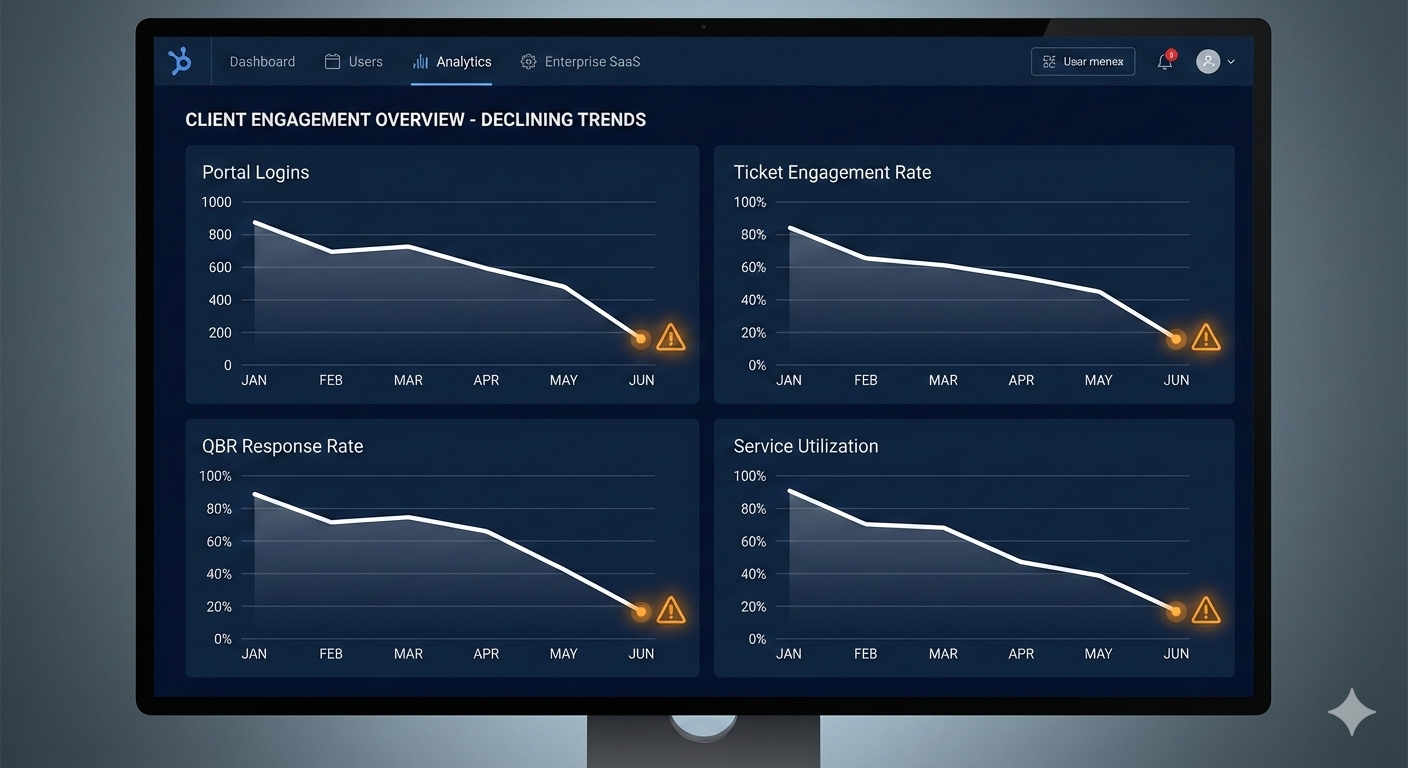
Consider a scenario that plays out in MSPs across the industry: an IT consultancy with a long-standing logistics client, no complaints on record, described internally as “one of our easiest accounts.” At renewal, the client moves to a competitor who “better understood their direction.” A post-mortem surfaces months of declining service utilization, slower responses to QBR follow-ups, and reduced portal engagement. The signals were there in the data. Nobody was watching for them.
The Solution
The first step toward solving silent churn is recognizing that it is a data problem before it is a relationship problem. Clients do not become disengaged overnight. The pattern builds gradually, in how they interact with your service portal, how quickly they respond to your team, how much of what they are paying for they actually use, and how meaningfully they engage with the reports you send them. Most MSPs are not monitoring any of this systematically. That is not a failure of care. It is a structural gap.
ScalePad’s 2025 MSP Business Trends Report confirms that MSPs with best-in-class customer satisfaction scores are significantly more likely to have higher client retention rates and to be projecting stronger revenue growth. The differentiator those top performers share is a formal customer success approach: client health tracking, technology roadmaps, and structured renewal strategies baked into their operations, not bolted on reactively.
The good news is that the data required to build that early warning system already exists inside your operations. Ticket volume trends, resolution times, portal usage, contract engagement patterns, and QBR participation rates all tell a story about a client’s health. The challenge is aggregating and interpreting those signals across every account, all the time, without hiring a dedicated team to do it.
This is where Prioriwise is built to help. Rather than requiring MSPs to staff a full customer success function, Prioriwise automates the intelligence layer that such a team would otherwise provide. The platform continuously analyzes your client data to surface early warning signals before they become churn events. When a client’s engagement pattern shifts, when utilization drops, or when the behavioral indicators that predict dissatisfaction begin to emerge, Prioriwise surfaces the risk so your team can act proactively, not reactively.
Prioriwise also directly addresses the other half of the silent churn equation: perceived value. Research by Benchmarkit, cited in the SerpSculpt 2025 retention report, shows that companies running structured account health programs see a net revenue retention lift of 6 to 12 percentage points. Firms that conduct regular QBRs report https://jumpcloud.com/blog/customer-retention-for-msps33% higher expansion revenue and a meaningfully lower likelihood of silent churn. Prioriwise automates the insight layer that makes those conversations possible, converting raw service data into clear, client-facing value narratives so that clients can see and articulate the return they are getting from your services before a competitor offers them an alternative framing.
What Changes When You Fix This
When an MSP has genuine, real-time visibility into client health across every account, the texture of the entire renewal process changes. You no longer enter renewal conversations hoping the client is satisfied. You enter them knowing it, because you have been addressing friction as it arose and communicating value throughout the engagement cycle, not scrambling to demonstrate it when the contract is up.
Your team stops treating quiet accounts as safe accounts. Silence becomes a trigger to investigate, not a comfort to rest on. The post-mortem conversations stop happening, because the indicators that used to precede a departure are now visible weeks or months in advance.
According to JumpCloud’s retention research, 44% of companies focus primarily on new client acquisition while only 18% focus on retention. MSPs that invest in structured retention intelligence benefit from compounding returns. The longer a client stays, the higher their lifetime value. The more proactively value is communicated, the stickier the relationship becomes. A client who sees a clear ROI statement every month is far less susceptible to a competitor’s pitch.
The operational benefits extend beyond revenue. Predictable renewal rates support more accurate revenue forecasting. Deeper client relationships create more natural opportunities to expand scope. And because Prioriwise handles the analysis and recommended actions automatically, none of this requires adding headcount.
Final Thoughts
At Prioriwise, silent churn is not just a product use case. It is a problem we consider genuinely unfair to MSPs who are delivering real results every day. You and your team do the work. Systems run. Tickets resolve. Security holds. And then a client leaves without ever giving you the chance to respond to a concern that was building quietly for months.
Our belief is that IT service providers should not have to choose between being a strong delivery organization and being a proactive customer success organization. With the right intelligence layer, those two things are not in conflict. The data already exists inside your operations. The signals are already there. What Prioriwise does is make them visible, interpretable, and actionable without requiring a dedicated customer success hire or a restructuring of how your team works.
The future of MSP growth is not purely about winning new logos. It is about building client relationships that are deep enough, and transparent enough, that leaving quietly becomes structurally difficult. Clients who understand what they are getting, who feel seen by their MSP, and who are engaged before problems escalate, simply do not churn silently. That is the outcome we are committed to helping IT service providers achieve, not as a one-time fix, but as a permanent capability baked into how they operate.

Key Takeaways
These principles apply to any MSP, regardless of what tools they use or how large their team is:
Silence is not satisfaction. Research shows that 96% of unhappy customers never complain before leaving. Absence of negative feedback is not confirmation that an account is healthy. Build the habit of watching behavioral signals – portal usage, service utilization, and QBR engagement – on an ongoing basis.
Churn risk is readable in the data before a client decides to leave. The indicators of disengagement tend to appear months before a renewal conversation. Systematize how you read them so that risk detection is not dependent on individual instinct or whether someone happens to notice.
Perceived value needs to be actively maintained, not assumed. Delivering great service is necessary but not sufficient. Clients who cannot see and articulate the ROI they are receiving are vulnerable to competitive alternatives. Regular, data-backed value communication is a retention strategy, not just a reporting obligation.
MSPs with formal customer success programs outperform those without. ScalePad’s 2025 MSP Trends Report found that MSPs running structured client engagement programs – including account health tracking and renewal strategies – are more likely to project higher growth and retain more revenue. A proactive approach to retention does not require a large team. It requires the right structure and visibility.
Ready to stop reacting and start predicting?
See how Prioriwise turns your delivery data into a live Relationship Health Score for every client.
Get Started