
The Revenue Already Inside Your IT Services Business That Most Firms Never Touch
Why Chasing New Logos Is Costing IT Service Providers More Than They Think And What to Do Instead
The Trap Most IT Service Providers Do Not Realize They Are In
There is a specific kind of pressure that sets in when you run an IT services firm.
The business feels like it only moves forward when new client names are added to the list. New logos feel like momentum. New contracts feel like validation. Revenue from a newly closed deal feels earned in a way renewal revenue somehow does not.
So the attention goes there. Sales. Marketing. Pipeline reviews. Outbound campaigns.
Meanwhile, the clients already under contract, the ones funding payroll and generating the recurring revenue your firm is built on, receive a fraction of that strategic focus.
Whether you operate as a traditional MSP, a co-managed IT partner, a security-focused provider, or a broader IT consultancy with recurring services, the pattern is the same.
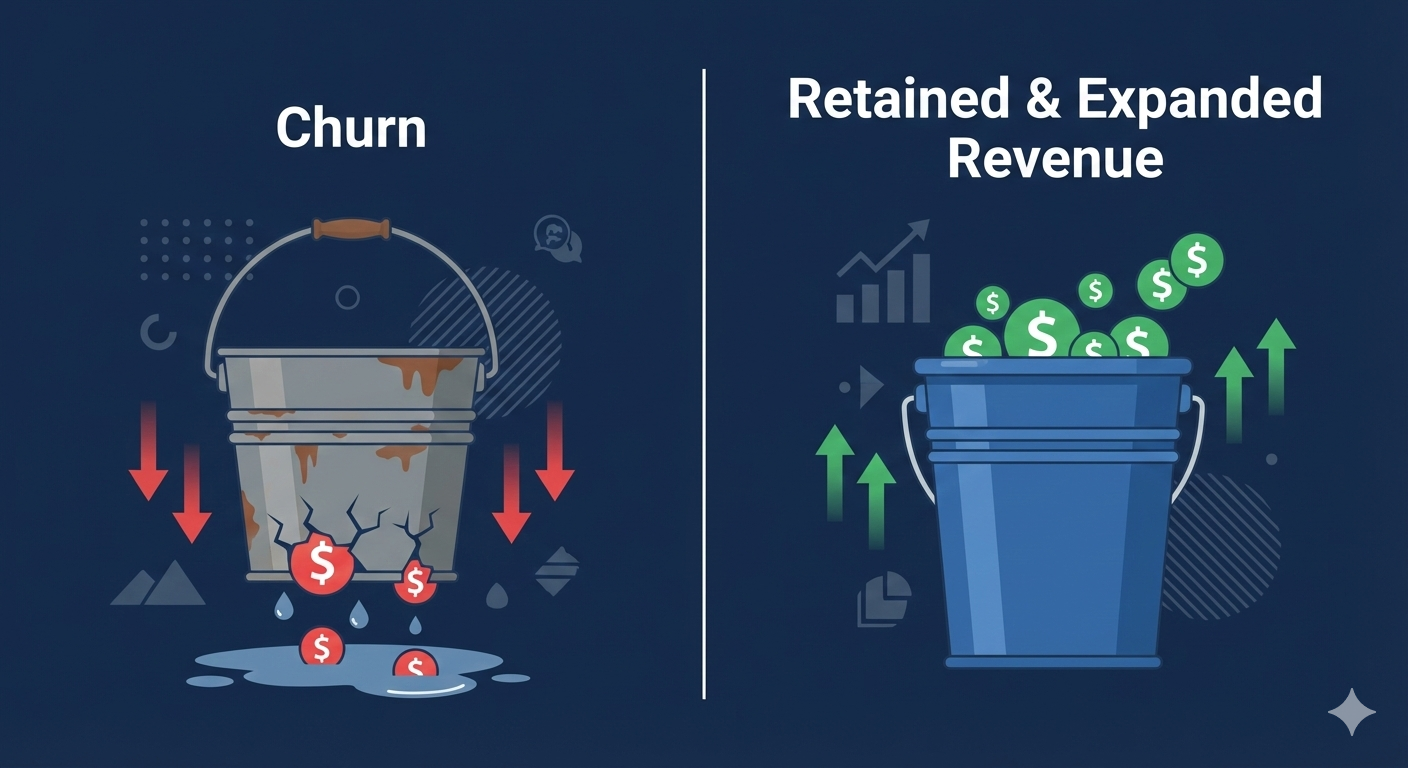
Most firms are pouring water into a bucket they have never checked for holes.
By the time they notice the holes, revenue is already gone.
What This Actually Costs IT Service Providers
The economics of new logo obsession are unfavorable.
According to research from Harvard Business Review, acquiring a new customer costs between 5 and 25 times more than retaining an existing one.
For IT service providers, that cost is amplified by onboarding realities:
Environment documentation
Tool deployment and configuration
Knowledge transfer
Early-stage ticket surges
Security baselining
Margin recovery takes months. If the client churns before that recovery point, the loss is direct and unrecoverable.
Yet new acquisition remains the primary stress driver. According to MSP Success, 64 percent of MSP owners cite new customer acquisition as their biggest business stressor. The dynamic applies broadly across IT services firms.
Meanwhile, cross-industry data from BusinessDasher shows companies have a 60 to 70 percent probability of selling additional services to an existing client, compared to just 5 to 20 percent with a new prospect.
The math is not subtle.
Existing clients are statistically easier to grow, cheaper to retain, and more profitable over time.
Yet most IT service providers are not structured to capitalize on that.
What This Looks Like in Practice
Revenue concentration risk goes undetected. A handful of clients may represent a disproportionate share of recurring revenue. If one leaves, the impact is structural.
Expansion opportunities are invisible. According to research aggregated by Barracuda and Infrascale, service providers are rapidly expanding their portfolios. But without structured account insight, those new services are not systematically introduced to existing clients.
At-risk accounts drift quietly. Clients rarely announce dissatisfaction. Early signals appear in engagement shifts, ticket friction patterns, and communication changes. Without structured monitoring, those signals go unnoticed.
Acquisition costs continue rising. Customer acquisition costs have increased significantly in recent years, according to benchmarks cited by SimplicityDX via GenesysGrowth. The treadmill is accelerating.
Consider a 40-client IT services firm with average monthly recurring revenue of 4,000 dollars and annual churn of 10 percent.
That is 192,000 dollars in annualized revenue that must be replaced before true growth begins.
Replacing revenue is not the same as growing revenue.
Plugging the Bucket and Then Building on It
The structural shift that changes the economics of an IT services business is this:
Move from monitoring service delivery to monitoring client relationships.
Most firms have operational infrastructure:
RMM
PSA
Ticketing systems
Monitoring tools
These platforms tell you whether services are being delivered.
They do not tell you whether the relationship is strengthening or weakening.
According to Sherweb, expanding revenue within existing accounts is significantly more profitable than relying solely on new acquisition.
The issue is not intent. It is infrastructure.
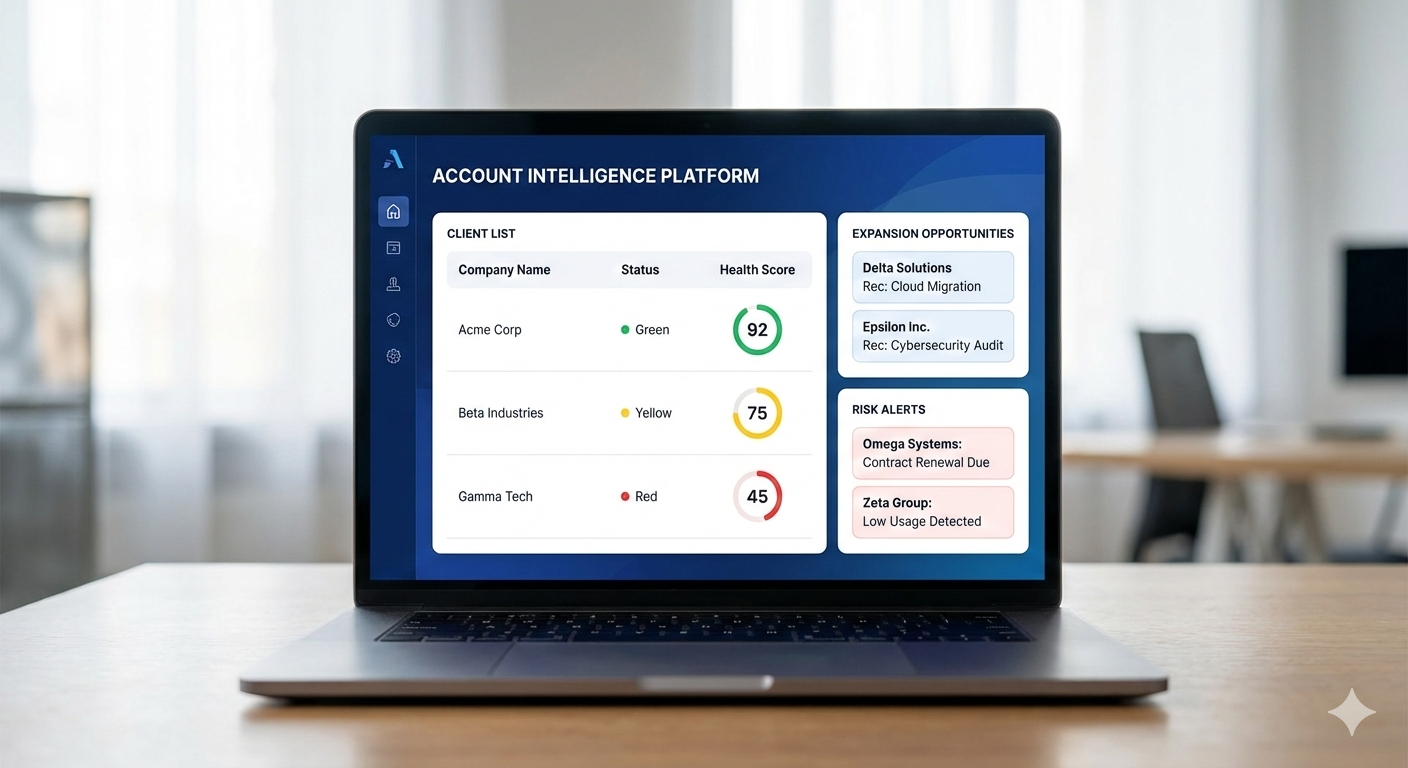
Most IT service providers lack an intelligence layer that continuously surfaces:
Account health signals
Engagement patterns
Early churn indicators
Natural expansion opportunities
This is the gap Prioriwise is designed to close.
Prioriwise continuously analyzes data across your service delivery stack and translates it into actionable account intelligence. It identifies which clients are engaged, which are drifting, and which present clear expansion signals.
It does not wait for cancellation notices.
It surfaces upstream conditions while there is still time to act.
Because the platform synthesizes operational and behavioral data, it can also flag:
Clients ready for security upgrades
Accounts whose growth supports service expansion
Underpriced engagements relative to delivered value
Environments signaling compliance risk
The result is not more dashboards.
It is structured, timely action.
What Changes When You Treat Your Client Base as a Growth Engine
The global IT services market continues to expand rapidly. According to projections cited by Grand View Research via MSP SEO Agency, managed and outsourced IT services are expected to see substantial long-term growth.
The firms that capture that growth will not be those constantly replacing churn.
They will be the ones whose existing clients grow with them.
When account intelligence is embedded into operations:
Renewal conversations become strategic
Upsell timing becomes data-driven
Revenue concentration risk declines
Net revenue retention improves
Business fragility decreases
The firm stops feeling like it is one cancellation away from disruption.
Final Thoughts
The IT services industry has invested heavily in service delivery infrastructure.
RMM platforms. PSA systems. Security stacks. Automation tools.
These are essential.
But delivery infrastructure and relationship infrastructure are not the same.
The second layer, protecting and expanding the value of client relationships, has largely been left to intuition and manual effort.
Prioriwise exists to systematize that layer.
Our conviction is simple:
Every IT service provider, whether an MSP, MSSP, cloud partner, or hybrid consultancy, should have access to structured account intelligence that turns existing relationships into a predictable growth engine.
The data already exists inside your business.
The leverage comes from activating it.
Ready to stop reacting and start predicting?
See how Prioriwise turns your delivery data into a live Relationship Health Score for every client.
Get Started