
The Hidden “Operational Tax” Killing Enterprise Growth in IT Services: A Customer Success Lens
How Customer Success (CS) teams are still reactive in an era where they should be strategic.
If you have ever worked in a large-scale technical services organization, the “Quarterly Review Season” likely triggers a specific kind of muscle memory.
It’s the memory of having fourteen browser tabs open at 9:00 PM on a Sunday. You are toggling between a Jira dashboard showing red-status projects, a Salesforce record with outdated notes, and a 50-slide corporate PowerPoint template that feels like a straightjacket. You aren’t thinking about your client’s business transformation. You are thinking about how to format a bar chart so the SVP doesn’t grill you on why “Ticket Volume” is up while “NPS” is down.
It feels wasteful because it is wasteful. You were hired for your strategic mind, your ability to navigate complex political landscapes, and your knack for identifying $5M expansion opportunities. Yet, here you are, acting as a high-priced data janitor.
The industry likes to claim we have a “talent gap” in Customer Success. They say CSMs aren’t “outcomes-focused” enough. But the truth is simpler: You cannot focus on outcomes when you are drowning in inputs.
The Anatomy of the Struggle
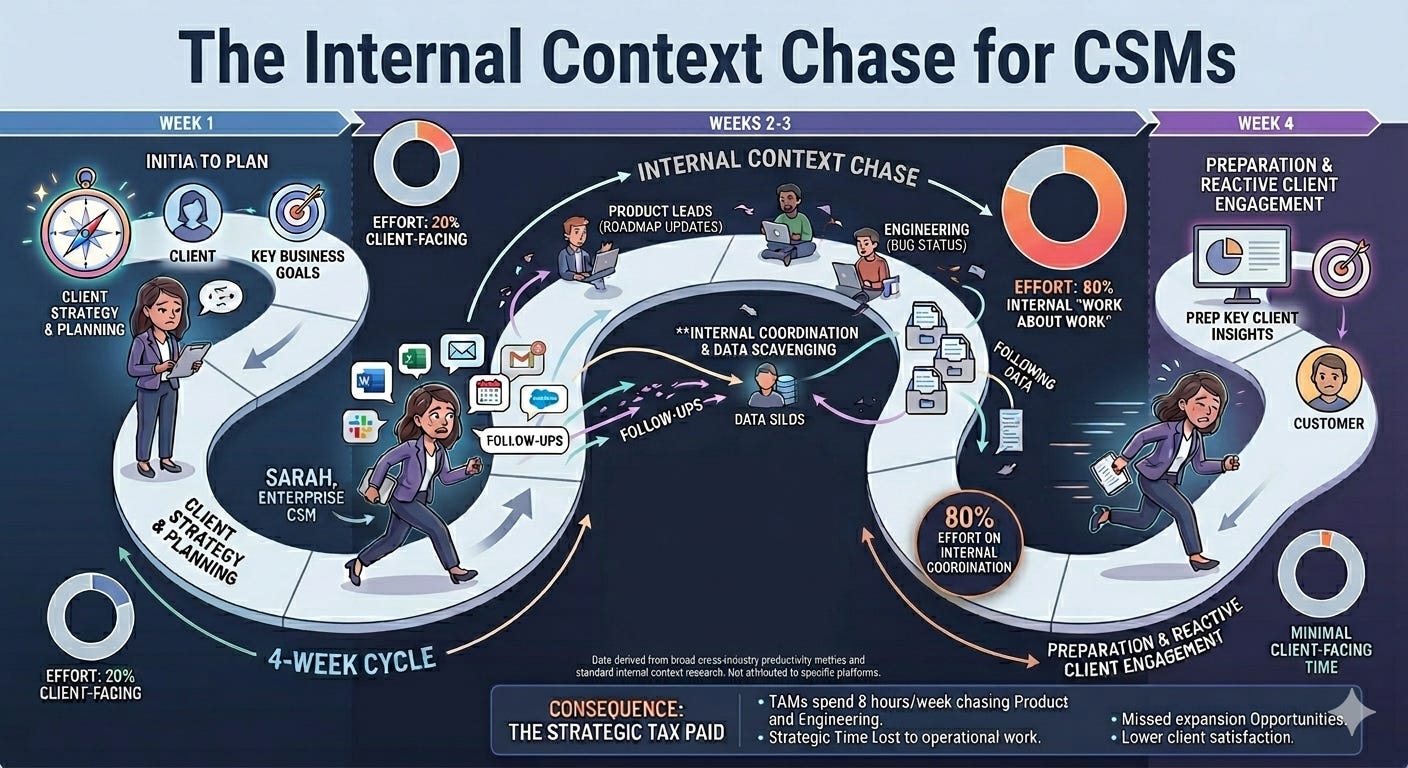
The journey map above illustrates the reality for most Enterprise CSMs: a 4-week cycle where 80% of the effort is spent on “internal coordination” and data scavenging, leaving only a fraction of time for actual client strategy. This “Internal Context Chase” is the silent killer of productivity. When a TAM spends 8 hours a week chasing Product leads for roadmap updates or Engineering for bug status, they are paying a “Strategic Tax.” According to Asana’s 2023 Anatomy of Work Global Index, “work about work”, the meetings about meetings and data searching now consumes 58% of the workday.
The AI Paradox: More Noise, Less Signal
We were told AI would solve this. Instead, we have “AI features” everywhere; AI-generated meeting summaries, AI email drafters, AI ticket categorizers.
The result? Signal Overload. Your team now has more data to sift through. Without a Best Practices Framework—a clear North Star of what actually constitutes “Customer Health”, “Business Value” and “Risk Score,” AI is simply a faster way to be confused. Most tools are just “chatbots over data”; they don’t tell you what to do next.
The “Defensive” QBR: A Billion-Dollar Revenue Leak
In his latest analysis for Forbes, Stephen Diorio highlights the “Hidden Execution Gaps” that derail even the best strategies. Diorio argues that growth leaders often fail because they treat GTM as a series of handoffs rather than a unified system.
When your QBR preparation is a frantic scramble for data, your presentation becomes a shield. You report on SLAs to prove you didn’t fail, rather than presenting a roadmap for how the client can win. This is the ultimate execution gap: a strategy for growth that dies in a spreadsheet.
Quantifying the “Missed Expansion”
The cost of this friction is not just morale—it is a direct hit to Net Retention Rate (NRR). In the current market, NRR is the primary driver of valuation.
The Expansion Gap is staggering: For an enterprise professional managing a $50M portfolio, missing just a 2% expansion opportunity due to a lack of proactive insight results in **$1,000,000 in lost revenue per year, per head.** According to Gainsight’s 2024 State of CS Report, the #1 challenge for CS teams this year is “driving expansion revenue”—yet only 24% of teams feel they have the right data to do it.
Why Prioriwise is Different: Framework Over Features
Prioriwise doesn’t just add more “AI noise” to your workflow; it provides the Signal and Action Layer that bridges Diorio’s “execution gap.”
Framework-First Intelligence: Unlike generic AI, Prioriwise is built on a best-practices framework specific to IT services. It knows what a “Relationship Risk” signal looks like in an email, and how it correlates to a “Delivery Delay” in your PSA.
Bridging the Context Gap: It spans the tech stack, unstructured communication, structured ticket data, and industry benchmarks, to create a unified “Account Intelligence” record.
Playbooks, Not Just Reports: Prioriwise doesn’t just give you a dashboard; it creates client-ready playbooks (QBRs, renewal decks, SOWs) including talk tracks. It translates “Technical Metrics” into “Business Outcomes” like Revenue Protection and Risk Mitigation.
If you want your teams to be outcomes-focused, you have to stop asking them to be data processors. It’s time to stop paying your best people to be janitors and start giving them the tools to be the growth engines you hired them to be.
Stop Paying the Tax. Start Capturing the Growth.
If you are tired of your best strategic minds spending their weekends in spreadsheets, it’s time to change the system. Give your team the signal layer they need to actually lead.
Ready to see your “Hidden Execution Gaps”?
If you are ready to see how your delivery data can be translated into growth, book a call here and let’s bridge the value gap together.
Thank you for reading.
Urvashi
(Cofounder/CEO of Prioriwise)
Disclaimer: The core ideas and strategic insights within this article are the original work of the author, reflecting real-world experience in the IT services sector. AI was utilized as a collaborative tool to assist in data structuring, drafting, and refining the presentation of these concepts.
Ready to stop reacting and start predicting?
See how Prioriwise turns your delivery data into a live Relationship Health Score for every client.
Get Started