The "Ghost Margins" in IT Services: Is Your Customer Success Team's Time a Resource or a Cost?
How to stop the "Reactive Tax" from eating your EBITDA and bridge the Value Gap with AI.
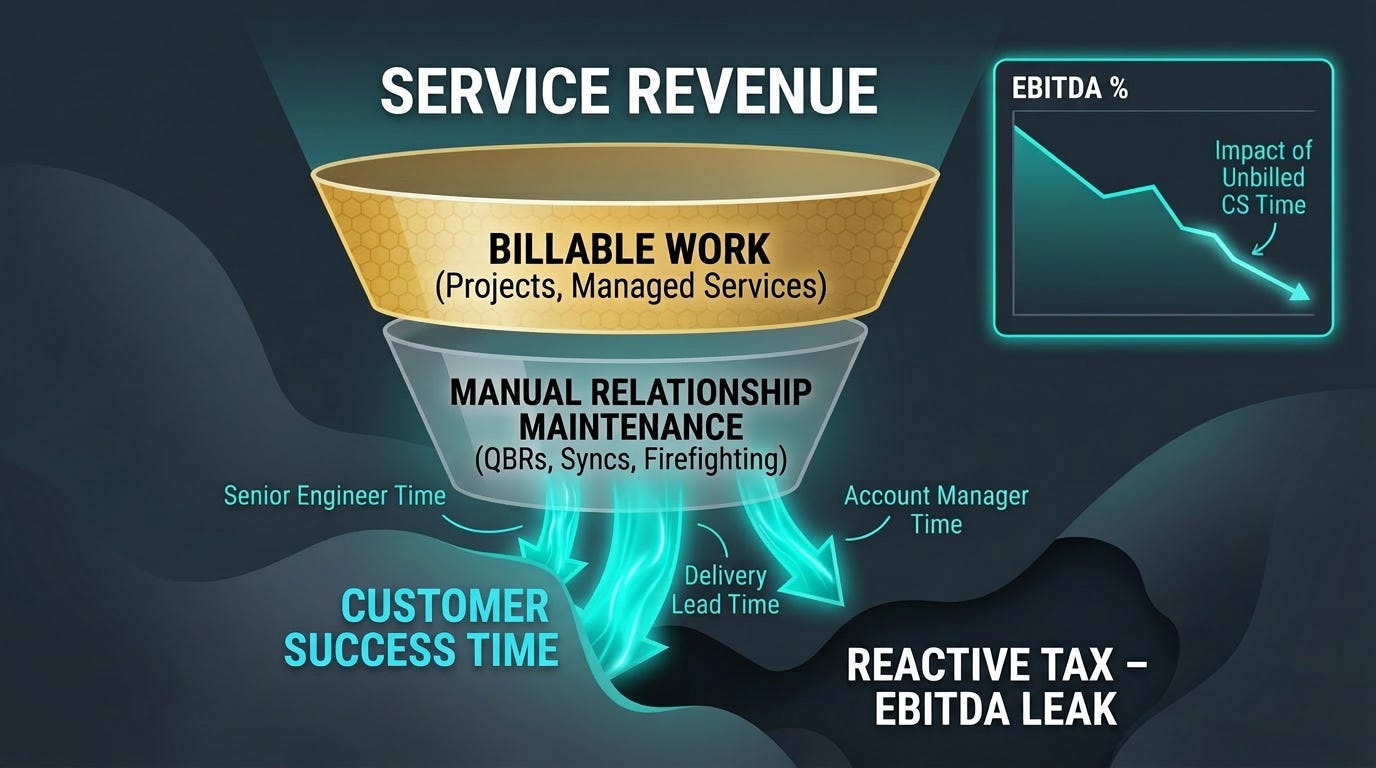
For the CEO of an IT Service Provider, the most expensive line item isn’t software but rather it’s Time. Specifically, the time of your senior engineers, delivery leads, and account managers. When these high-value resources are diverted from billable work to “manual relationship maintenance,” your EBITDA doesn’t just dip, it leaks.
We call this the “Reactive Tax.”.
The Resource Trap: High-Value Talent, Low-Value Tasks

In most IT Service firms, as you scale, your Customer Success teams get pulled into a cycle of “Manual Success”:
The Data Janitor Phase: Spending 4-6 hours per client pulling disparate logs and tickets to build a QBR deck.
The Defensive Crouch: Scouring emails and Slack to figure out why a client is “quiet,” trying to detect risk before it becomes a cancellation.
The Unbilled Strategic Gap: Giving away high-level consulting during “sync calls” just to keep the client happy, without ever capturing that value in a Statement of Work (SOW).
When your most senior resources are stuck in this loop, they aren’t looking for growth, they are just trying to survive the week. This is where Ghost Margins live: in the expansion opportunities your team is too busy to see.
Turning Data from a Weight into a Lever
Your delivery data (emails, tickets, sentiment, project drift) is currently a weight that your team has to carry and manually synthesize.
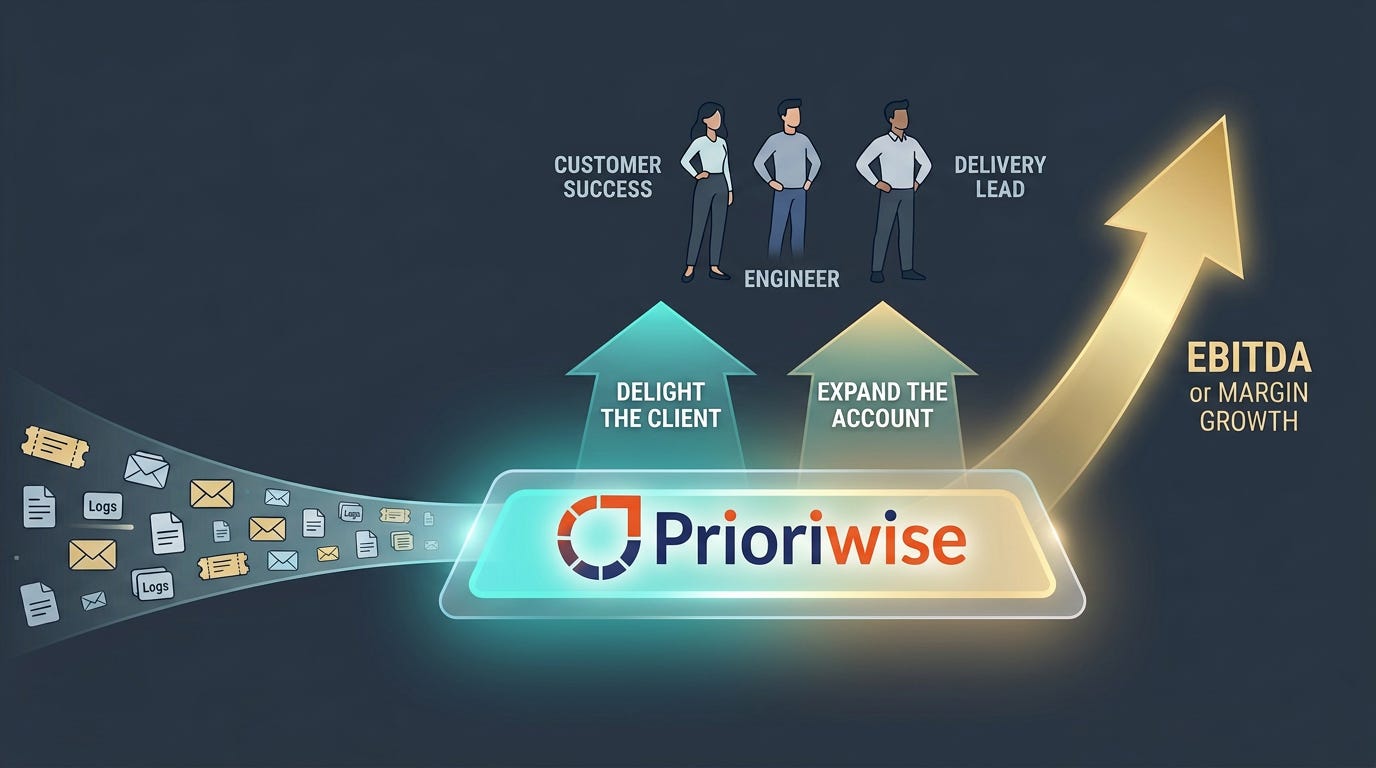
Prioriwise turns that data into a Resource Multiplier. Instead of asking your team to “find the signal,” our AI engine delivers the signal to them:
Automated Value Stories: It synthesizes technical work into “Business Impact” reports (Revenue Protection, Cost Avoidance) in seconds.
Immediate Expansion Signals: It identifies exactly where a client’s needs have evolved, allowing your team to move straight to the Statement of Work (SOW) rather than the discovery phase.
Proactive Risk Guardrails: It flags “Sentiment Drift” 60 days before a renewal, so your team spends 1 hour on a fix rather than 40 hours on a “Save.”
The EBITDA Strategy: Resource Arbitrage
Increasing your margins isn’t about working harder; it’s about Resource Arbitrage. It’s about offloading the “Data Janitor” work to an AI layer so your human talent can focus on the only two things that move the needle: Delighting the client and expanding the account.
If your best people are spent on manual reporting, you aren’t scaling, you’re just getting busier. It’s time to stop paying the “Reactive Tax” and start capturing your Ghost Margins.
Is your Customer Success team too busy to grow? We’re running “Resource Recovery Audits” for IT Service Providers this month. We’ll show you how much manual effort Prioriwise can reclaim and identify the hidden expansion revenue sitting in your data right now. Book you audit here.
Thank you for reading.
Urvashi
(Cofounder and CEO of Prioriwise)
Disclaimer: The ideas and core content in this article are the author’s own, however, it was written with the assistance of AI.
Ready to stop reacting and start predicting?
See how Prioriwise turns your delivery data into a live Relationship Health Score for every client.
Get Started