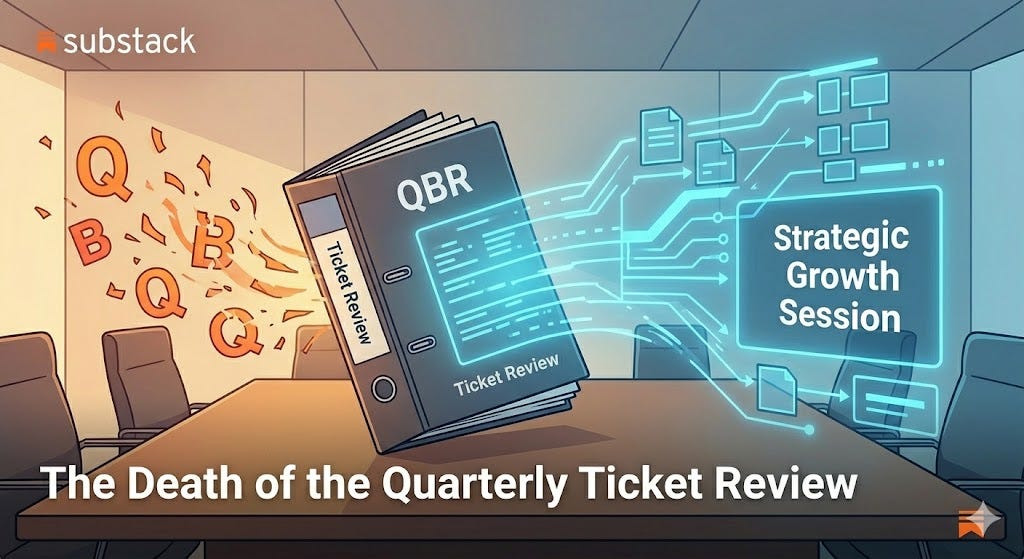
The Death of the Quarterly Ticket Review
Transforming Your QBR from a Dull "Time Tax" into a High-Value Strategic Growth Engine
The Narrative: The Glazed-Eye Syndrome
You’ve spent five hours prepping the “Big Deck.” You sit down with the CEO, ready to prove your worth with uptime charts and patch counts. Ten minutes in, you see their eyes glaze over. They start checking their phone. By the twenty-minute mark, they’re asking to “wrap this up early.”
You’ve fallen into the Review Trap. You’ve treated a strategic alignment meeting like a middle-school book report.
The Conflict: Technical Reporting vs. Strategic Consulting
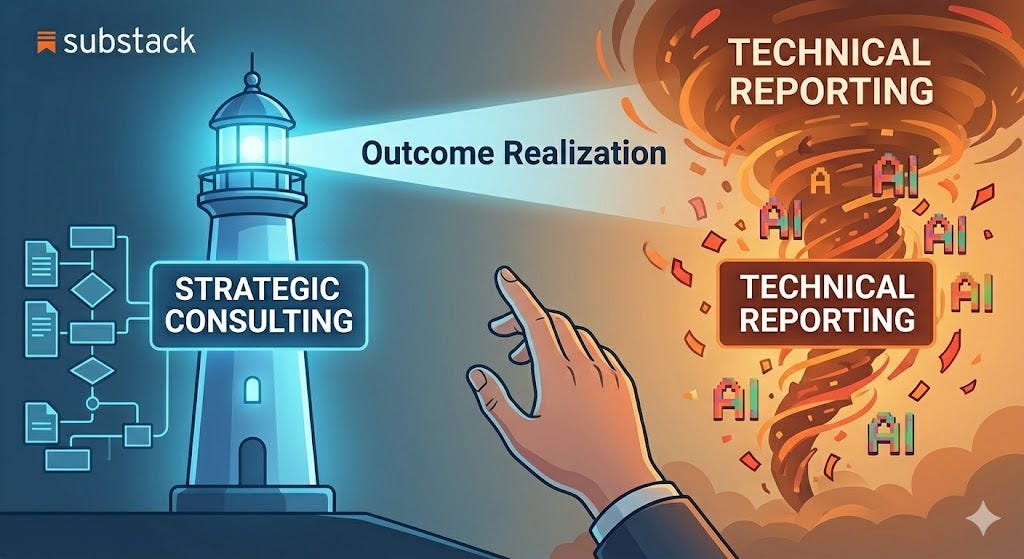
The CEO doesn’t care about the patches; they care about the protection those patches afforded their revenue. They don’t care about the uptime; they care about the continuity of their operations. When we talk tech, we are a cost center. When we talk outcomes, we are a growth engine.
The Strategic Pivot: The 80/20 QBR
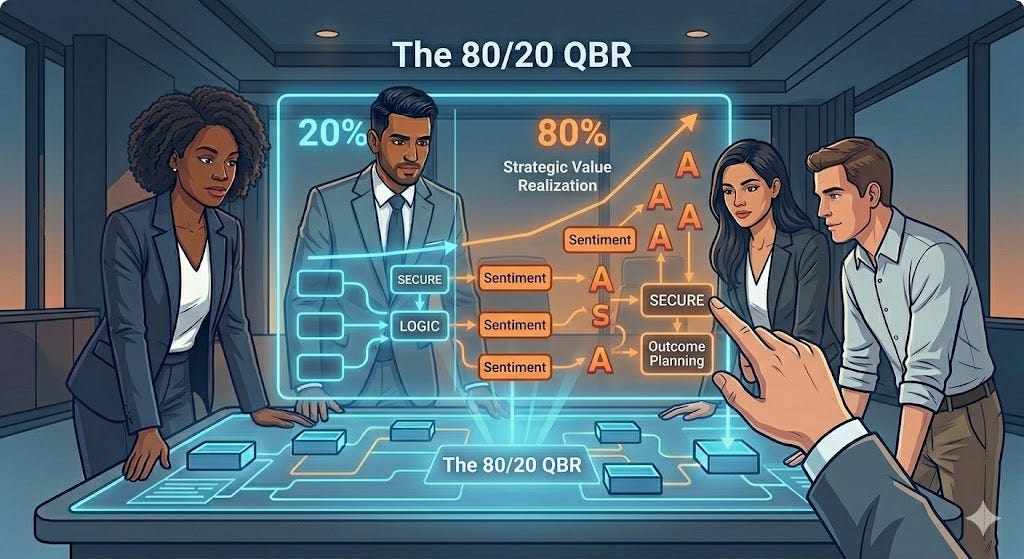
The “Quarterly Business Review” needs to be replaced by the “Strategic Growth Session.”
The Leadership Playbook
If your QBR is a “look back” at tickets, you are positioning yourself as a janitor. To be a consultant, your QBR must be a “look forward” at the client’s P&L.
1. The 20%/80% Rule: Strictly limit the “What We Did” (historical reporting) to no more than 20% of your total scheduled time. Spend the remainder on “Where You Are Going” (business goals). If you have nothing to say for the remaining 80%, you don’t know your client’s business well enough.
2. The “Golden Question” Opener: Start every meeting by asking: “Since we last met, what has changed in your top three business priorities?” This forces the client to stop thinking about IT and start thinking about their own growth which you support.
3. Identify the “Value Gap”: Use the session to find “Whitespace.” If they are expanding to a new office or hiring 20 people, that is a business problem that requires an IT solution.
The Takeaway: Your job isn’t to report on the past; it’s to de-risk the future. A successful meeting isn’t one where the client agrees you did a good job—it’s one where the client asks for your help with a new project. Stop reporting on uptime; start consulting on growth.
Side Note: Inspired by the industry-wide struggle to transition vCIO and Account Management roles from “technical reporting” to “business consulting.”
Thank you for reading.
Urvashi Batra
(Cofounder/CEO of Prioriwise)
Disclaimer: The core ideas and strategic insights within this article are the original work of the author, reflecting real-world experience in the IT services sector. AI was utilized as a collaborative tool to assist in data structuring, drafting, and refining the presentation of these concepts.
Ready to stop reacting and start predicting?
See how Prioriwise turns your delivery data into a live Relationship Health Score for every client.
Get Started