If You Don't Know Where You're Going, Any Road Will Take You There
How the MSPs with the strongest retention, highest ARPU, and most natural expansion revenue all share one thing: they start with the client's business, not the technology
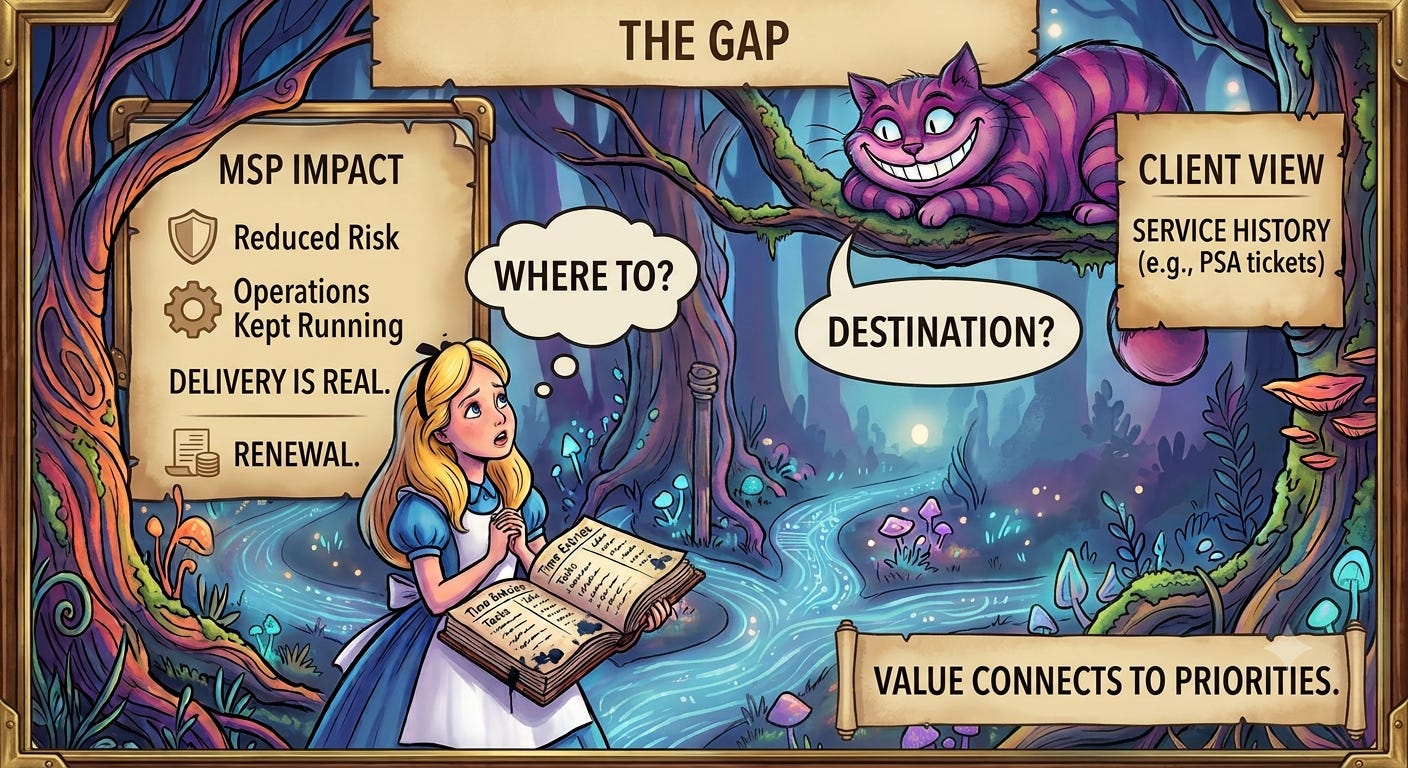
We all know this exchange from Alice in Wonderland. Alice asks the Cheshire Cat which road she ought to take. The Cat asks where she wants to go. Alice says she doesn’t much care. “Then it doesn’t matter which way you go,” the Cat replies.
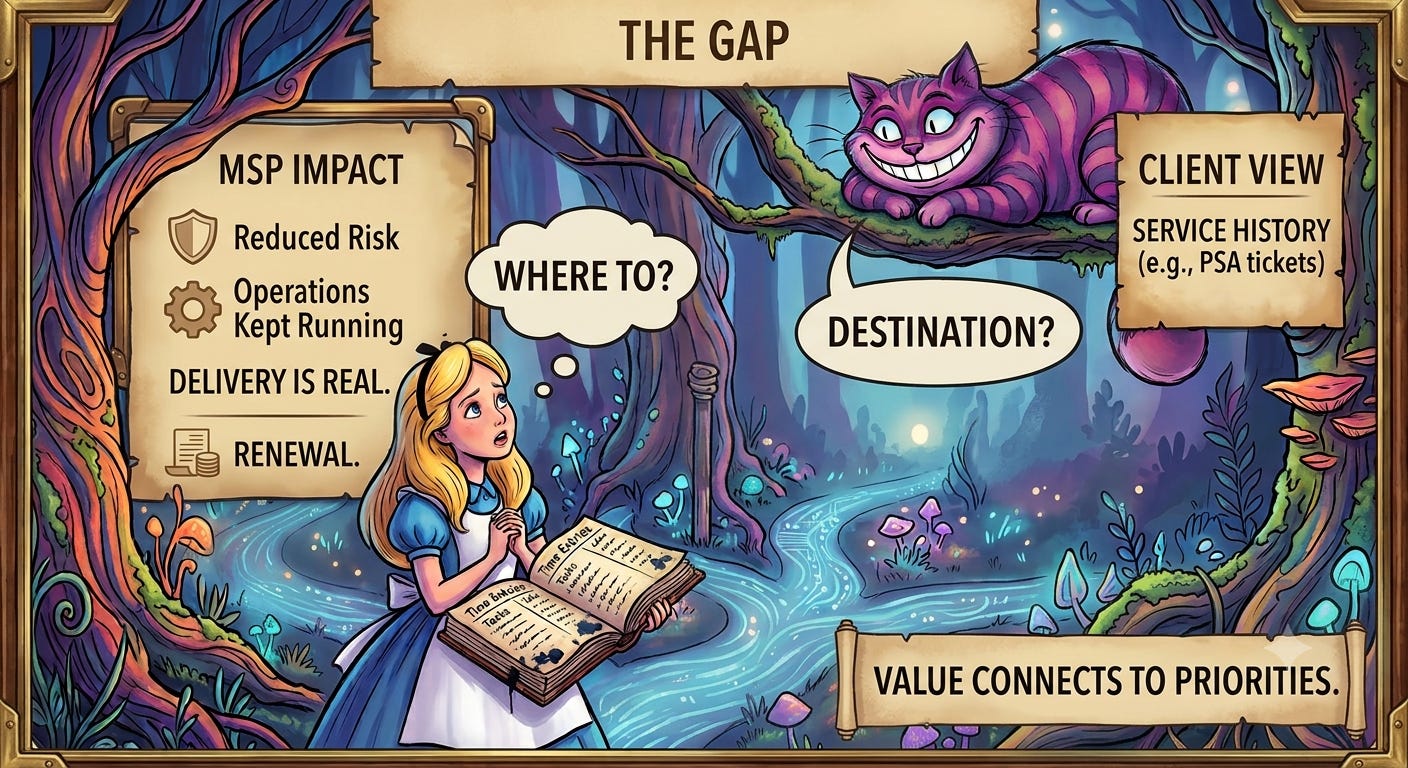
It’s a line that gets quoted at leadership off sites and printed on motivational posters. But it describes something very real about how many MSP client relationships are structured today. The work gets done. The road gets traveled. But if neither party has agreed on the destination, the direction is almost beside the point.
MSPs are doing important work every day. Closing tickets, patching devices, reducing risk, responding to threats, keeping businesses running. The delivery is real. The effort is genuine. And yet, many client relationships feel fragile at renewal time.
That tension has a name: the value perception gap. The MSP sees impact. The client sees activity. And when a client can’t connect the work to their business priorities, the relationship becomes transactional and, ultimately, replaceable.
The underlying cause is structural. Every quarter, account teams spend hours pulling data from disconnected systems: PSA tickets, CRM notes, contracts split across platforms, only to produce a report that reads like a tech-support receipt. Clients receive a rearview-mirror view of what happened to their infrastructure, not a forward-looking picture of where their business is going. The MSP is doing the work. The client isn’t seeing the value.
A recent article from MSPGlobal put it directly: MSPs who align their services with client business objectives are better positioned to improve retention, build trust, and uncover growth opportunities naturally. The piece argues that understanding where a client is trying to go isn’t a “nice to have.” It’s becoming the primary differentiator in a market where technical competency is increasingly assumed.
The data backs this up1 2 3 4.
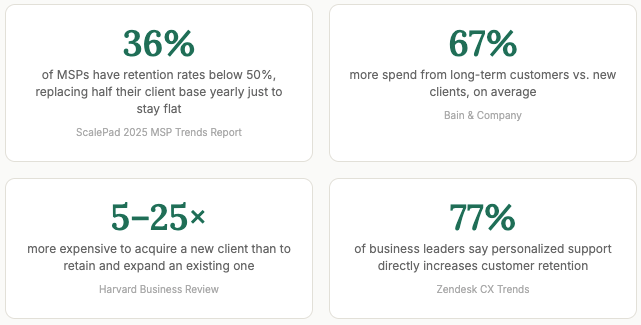
High churn doesn't just hurt revenue. It turns your new-logo pipeline into a treadmill. Every acquisition investment simply offsets losses rather than driving compounding growth. The MSPs with the strongest financials, highest ARPU and highest recurring revenue rates, consistently show client retention above 76%. That number isn't accidental. It's the result of relationships built on relevance, not just responsiveness.
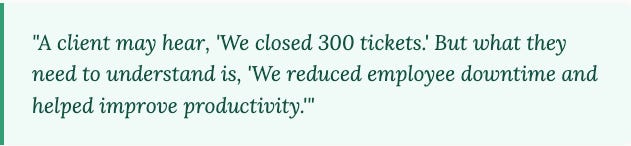
The Translation Problem
The same technical work becomes far more valuable when it is connected to a business reason. This isn’t about spin. It’s about making visible what is actually true. The MSP’s work often does reduce operational risk, improve resilience, and protect productivity. But if that story isn’t told, the client only sees a service invoice and a ticket count.
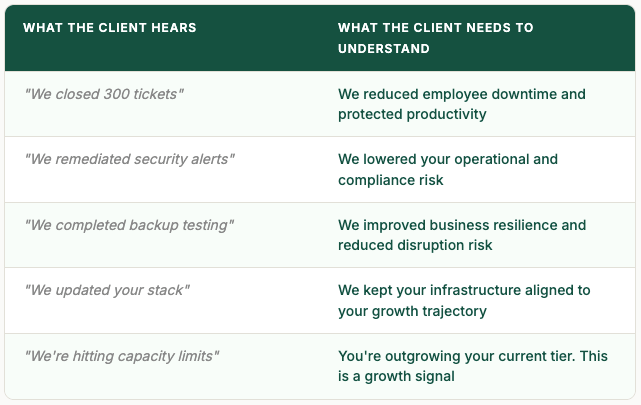
This translation gap shows up most clearly in QBRs. More than two-thirds of MSPs report their clients now expect them to play a strategic role, not just a technical one. Yet many QBRs still open with ticket counts, uptime percentages, and patching statistics. When the agenda is dominated by operational minutiae, the business conversation disappears. And when that happens, clients start to tune out, often without the MSP realizing it.
A Roadmap Should Not Begin with Tools
Many technology roadmaps start with a familiar set of questions: What systems need upgrading? What devices are aging? What security tools should be added? These are important questions, but they are not the first questions.
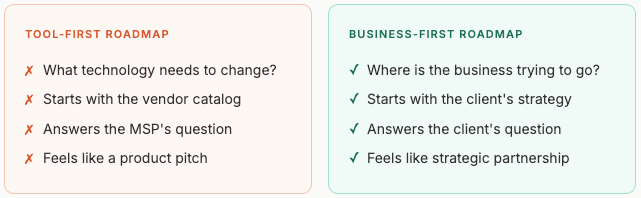
Consider three common client situations:
A client expanding into new locations doesn’t just need networking or devices. They need scalable onboarding, identity management, security standards, and operational consistency. The roadmap that wins is the one that sees the business initiative, not just the infrastructure requirement.
A client preparing for a compliance audit doesn’t just need security tools. They need governance, documentation, access controls, incident response readiness, and executive confidence. The MSP who shows up to that conversation with a firewall upgrade quote is speaking the wrong language.
A client wanting to adopt AI doesn’t begin with an AI tool. The conversation starts with data readiness, security posture, governance, workflow visibility, and the business processes AI is meant to improve. MSPs who understand this become the strategic gateway, not the afterthought.
The Questions That Change the Conversation
Strategic alignment starts before the first recommendation. It starts with better questions, ones that shift the entire frame of the relationship.
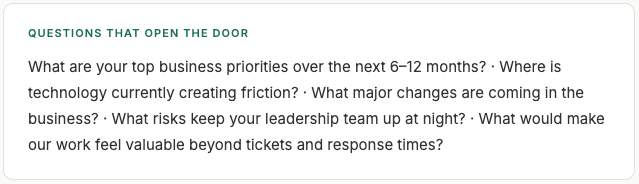
These aren’t sales questions. They’re strategic ones. And they fundamentally change what kind of MSP you are in the room: from a vendor answering “what do you need from IT?” to a partner asking “what is the business trying to achieve, and how can technology help you get there?”
For vCIOs and account leads running QBRs, this shift from technical reporter to strategic partner is the difference between a relationship that renews automatically and one that gets shopped every cycle.
Only 38% of MSPs currently consider customer satisfaction a key performance indicator. The majority focus almost entirely on ROI metrics. That’s a gap, because a positive client experience is directly tied to retention and expansion. The MSPs who ask better questions get better answers, build stronger relationships, and win more renewals without having to fight for them.
The Signals MSPs Are Already Sitting On
Goal alignment starts with the right questions. But for most MSPs, the answers are already in the data, just fragmented across systems no one is looking at together.
A client logging tickets from one department every week isn’t just generating support volume. They may be signaling a workflow bottleneck or a capacity constraint they haven’t articulated yet. A new executive joining the org is a strategic inflection point. A string of security incidents may indicate a compliance conversation waiting to happen. A client expanding locations is already telling you they need scalable onboarding, identity management, and device standards, before they ask for them.
These are expansion signals: moments when a client’s business is moving in a direction that creates a natural next step. The MSPs who catch them early don’t have to sell. They show up to the next conversation already speaking the client’s language.
The challenge isn’t that these signals don’t exist. It’s that they’re buried across PSA tickets, meeting notes, CRM records, and project updates. No single person can consistently surface them for every account, every quarter.
Turning Fragmented Data into a Forward View

This is where purpose-built tooling has a concrete role to play. Not AI for its own sake, but an engine that automatically ingests and normalizes the data already living in your PSA, your meeting transcripts, and your ticketing system, without replacing any of those tools.
The output isn’t another dashboard. It’s a live intelligence layer: which clients are showing early signs of outgrowing their tier, which accounts have shifting priorities that haven’t surfaced in a conversation yet, and which QBR is sitting on a natural expansion opportunity that’s currently invisible.
The conversation moves from “here is what we fixed” to “here is where we think you’re going, and how we can help you get there.” That is a fundamentally different relationship, and it’s available to any MSP willing to stop narrating the past and start mapping the future.
The Importance of Alignment

When MSPs understand where a client is trying to go, growth stops feeling like selling and starts feeling like helping. The best expansion opportunities don’t come from pushing more product. They come from seeing the next step in the client’s journey before the client thinks to ask for it.
If the client is expanding locations → scalable networking, onboarding, device management, security standards.
If the client is preparing for a compliance audit → governance, access control, documentation, incident response planning.
If the client is under margin pressure → automation, cloud optimization, tool consolidation.
If the client wants to adopt AI → data readiness, security, governance, workflow design.
This is what makes an MSP feel less like a vendor and more like a strategic partner. Not because they have more tools. Because they understand the client’s direction.
Thank you for reading.
Urvashi Batra
(Cofounder/CEO of Prioriwise)
Disclaimer: The core ideas within this article are the original work of the author, reflecting real-world experience in the IT services sector. AI was utilized as a collaborative tool to assist in data structuring, drafting and refining the presentation of these concepts.
1ScalePad 2025 MSP Trends Report
2Calculating Customer Retention Benefits
3The Value of Keeping the Right Customers
4Ready to stop reacting and start predicting?
See how Prioriwise turns your delivery data into a live Relationship Health Score for every client.
Get Started