
Find Hidden Margin in Your Existing Clients with AI Signals, Not in you QBRs when its too late
Connect contracts, usage, and cost-to-serve to surface pricing, packaging, and expansion moves your team can execute without relationship risk.
The margin leaks you feel, but can’t prove fast enough
You already know the pattern: an account “looks healthy” right up until the renewal turns into a scramble. The client wants a discount, leadership wants net retention, and your team is stuck stitching together the story from a contract PDF, a PSA report, a ticketing queue, and whatever your senior engineer remembers from six months ago.
Meanwhile, the work keeps happening. Extra after-hours requests, unplanned onboarding support, “quick questions” that turn into mini-projects, premium-level expectations on a basic package. You can feel the margin leaking, but proving it cleanly, early, and in a way that protects the relationship takes time you don’t have.
How this shows up in real MSP and IT service delivery
You renew on price because you can’t renew on value. When the value narrative isn’t quantified, the strongest lever left is discounting. You know the client is getting outcomes, but you can’t produce a client-ready business case quickly enough to hold the line.
Your packaging drifts while nobody notices. Clients start on a “standard” plan, then slowly consume premium behavior: faster response expectations, more tooling, more escalations, more advisory time. The contract doesn’t change, but the delivery reality does.
Your best clients become your least profitable. High-touch accounts can be great references and still quietly unprofitable. Ticket volume rises, senior engineers get pulled in, and the account becomes a margin sink you keep feeding because the relationship feels important.
CSMs and AMs spend their week on reporting, not outcomes. Your customer success motion becomes a cycle of manual exports, dashboard screenshots, and “health” conversations that don’t translate into commercial action.
Expansion gets missed because building the case is too hard. You see signals that the client is ready for more, but turning telemetry and delivery stats into a clear business narrative takes hours. So it slips until the client buys elsewhere or solves it internally.
A quick illustrative example that probably feels familiar:
An MSP signs a 120-user managed services agreement at a thin but acceptable margin. Six months in, ticket volume triples due to a new line-of-business app rollout, onboarding was rushed, and two execs start requesting strategy calls. The CSM senses risk and opportunity, but can’t quickly connect the contract’s included scope, the spike in escalations, and the premium-level usage pattern. Renewal comes, the client asks for a discount “because support hasn’t been great,” and the provider concedes to protect the logo. Everyone’s busy. Nobody’s happy.
If you’ve been in that cycle, it’s frustrating because the answers are in your data, just not in one place, and not in a form your team can act on confidently.
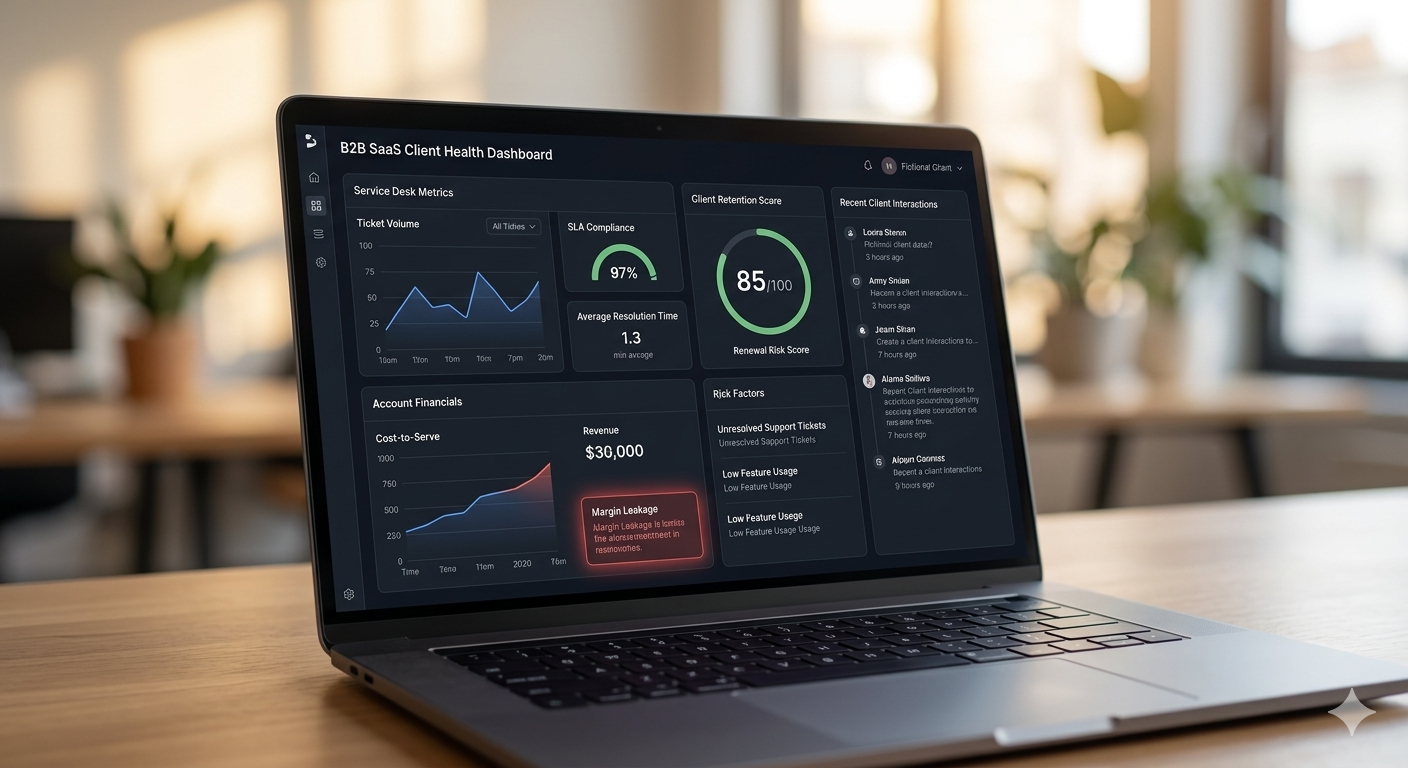
What good looks like: margin hygiene that doesn’t feel like policing
The goal is not to turn Customer Success into a pricing enforcement team. The goal is to make margin and expansion a natural byproduct of clarity.
Good looks like this:
You can see, early, which accounts are drifting out of package.
You understand cost-to-serve in plain terms, tied to the contract and to the outcomes you deliver.
You know which clients are primed for an upsell because their behavior already proves the value.
Your team gets clear recommendations with context, not just dashboards.
Conversations with clients stay relationship-safe because you’re grounding changes in evidence and outcomes, not surprise invoices.
This is where AI becomes practical, not theoretical. Most MSPs and IT service providers already have the raw ingredients: PSA data, ticketing history, monitoring alerts, project notes, contract language, and renewal records. The bottleneck is connecting them, interpreting them, and translating them into decisions a CSM or AM can take.
Prioriwise is built for that signal-and-action layer. It detects relationship risk, shifting priorities, and revenue opportunities early, then tells teams what to do next.
Here’s how that translates into hidden margin discovery inside your existing book:
AI signal detection across the systems you already run. Prioriwise pulls operational truth from PSA, ticketing, and monitoring sources like ConnectWise, ServiceNow, Jira, and Datto. Instead of asking a CSM to reconcile five dashboards, it watches for patterns that matter commercially.
Packaging and entitlement drift detection. When delivery behavior looks like a higher tier, Prioriwise can flag it as a packaging mismatch. That might be heavy usage, repeated after-hours support, frequent escalations, or ongoing advisory time that exceeds what the agreement supports.
Cost-to-serve signals that point to fixable root causes. High ticket volume is not always “bad clients.” Sometimes it’s onboarding gaps, missing documentation, or an unmanaged change in the environment. Prioriwise helps connect spikes to likely drivers so your next step is more than “do a QBR.”
Automatic translation of delivery data into business value language. Your client does not care about ticket categories. They care about uptime, productivity, risk avoided, and time saved. Prioriwise turns delivery signals into client-ready narratives that support renewal strength and expansion logic.
Proactive identification of at-risk clients and expansion opportunities. Risk and growth often show up together. A client pushing the boundaries of scope could be unhappy, or they could be signaling readiness to expand. Prioriwise surfaces both, early, with recommended actions to keep the conversation constructive.
Automated, client-ready reporting that reduces “prep tax.” Instead of spending nights building renewal decks, your team can walk into the right conversation with a clear story: what changed, what value was delivered, what’s drifting, and what the best next commercial step is.
The point is not replacing judgment. It’s giving your CSMs and AMs enough clarity to act like trusted advisors with a margin-aware backbone.
What your team looks like after the fire drills stop
When you fix this, you don’t suddenly have “less work.” You have less chaos.
Your CSMs stop spending their week hunting for evidence and start spending it orchestrating outcomes. They go into client conversations with confidence because the story is already assembled: contract context, delivery reality, usage signals, and a clear recommendation for what to do next.
Your account reviews get shorter and sharper. Not because you’re skipping relationship building, but because you’re not wasting time debating the basics. The conversation moves from “How are things?” to “Here’s what changed in your environment, here’s the impact, and here are two options that protect outcomes and align scope.”
Renewals become calmer. You see risk earlier. You build the value narrative continuously instead of retroactively. Discounts become a choice, not a default.
Expansion feels more natural because it is based on observed behavior, not a sales script. If a client is consistently consuming premium-level service, the upsell is framed as alignment: “You’re already operating here. Let’s formalize it in a way that improves responsiveness and removes friction.”
And internally, finance and operations stop treating CS data as “interesting but unreliable.” You start sharing a common view of margin drivers, packaged expectations, and the triggers that predict churn or growth. Prioriwise is the enabler that makes those signals visible early enough to act on them.
Why this is a problem worth solving permanently
Prioriwise exists because IT service providers deserve tools that work as hard as they do.
You’re delivering critical services in messy, always-changing environments. You’re managing human relationships, technical complexity, and commercial constraints at the same time. It is unreasonable that your best decisions still depend on tribal knowledge, spreadsheet archaeology, and last-minute reporting marathons.
Our mission is to build infrastructure that turns delivery data into strategic clarity automatically. Relationship risk and revenue opportunity should never go undetected simply because the evidence is scattered across systems. Margin should not erode quietly while teams stay busy.
We believe the future of IT service delivery is AI-assisted, not AI-replaced. The best providers will combine human trust and negotiation skill with machine-level pattern detection and consistency. That is how you protect relationships, improve net retention, and grow efficiently without turning Customer Success into “more meetings.”
Key Takeaways
Treat margin as a customer success outcome, not a finance-only metric. If CS owns retention, it also needs visibility into packaging fit and cost-to-serve drivers that determine whether retention is profitable.
Stop waiting for renewal season to assemble the value story. Build a rolling narrative from operational signals (stability, responsiveness, risk reduced) so the renewal conversation is a continuation, not a scramble.
Operational spikes are commercial signals. Ticket volume, escalations, and after-hours requests are early indicators of mis-packaging, onboarding gaps, or shifting priorities. Respond with a plan, not just extra effort.
Make expansion feel like alignment, not selling. The safest upsells are grounded in observed usage and outcomes: “You’re already operating at this level, so let’s match the agreement to reality and improve results.”
Ready to stop reacting and start predicting?
See how Prioriwise turns your delivery data into a live Relationship Health Score for every client.
Get Started