Building an Integrated Customer Success Framework Inside Your MSP
How MSPs can turn customer success into a repeatable, scalable engine for retention and growth
Why MSPs Need a Customer Success Framework
Most MSPs have grown up around tickets, projects, and Service Level Agreements (SLAs). That structure keeps systems running, but it does not guarantee that clients feel guided, supported, or confident about the value they are getting. As expectations rise in 2025, the promise of “we fix things fast” is no longer enough to secure renewals and expansion.
According to ScalePad’s analysis on Understanding Customer Success, the industry is rapidly moving beyond uptime and ticket metrics toward a model defined by business outcomes. Clients want predictable engagement, clear outcomes, and a partner who actively steers them toward better ways of working. Node4’s report on How MSP Services Are Evolving in 2025 confirms that clients now judge providers on productivity and digital transformation rather than just availability. A customer success framework provides the mechanism to deliver this consistency. Instead of relying on individual account managers to “do a good job,” the framework defines how every client is onboarded, supported, reviewed, and renewed. It becomes the operating system for relationships—turning retention and growth into something you can plan for, not hope for.
The Core Pillars of an Integrated Framework
A strong customer success framework inside an MSP usually rests on five pillars:
Predictable onboarding: Every client starts with clarity and momentum, not chaos.
Ongoing health monitoring: You track leading indicators of risk and opportunity, not just incidents.
Structured business reviews: Conversations are tied to outcomes, not just activity.
Adoption and enablement: Tools and processes are actually used, not just deployed.
Proactive, async communication: Clients feel informed without constant meetings or scattered messages.
Prioriwise.ai sits across these pillars as the coordination layer — giving you async-first workspaces, playbooks, and automation so the framework is executable by the whole team, not locked in one person’s head.
Designing Predictable, High-Confidence Onboarding
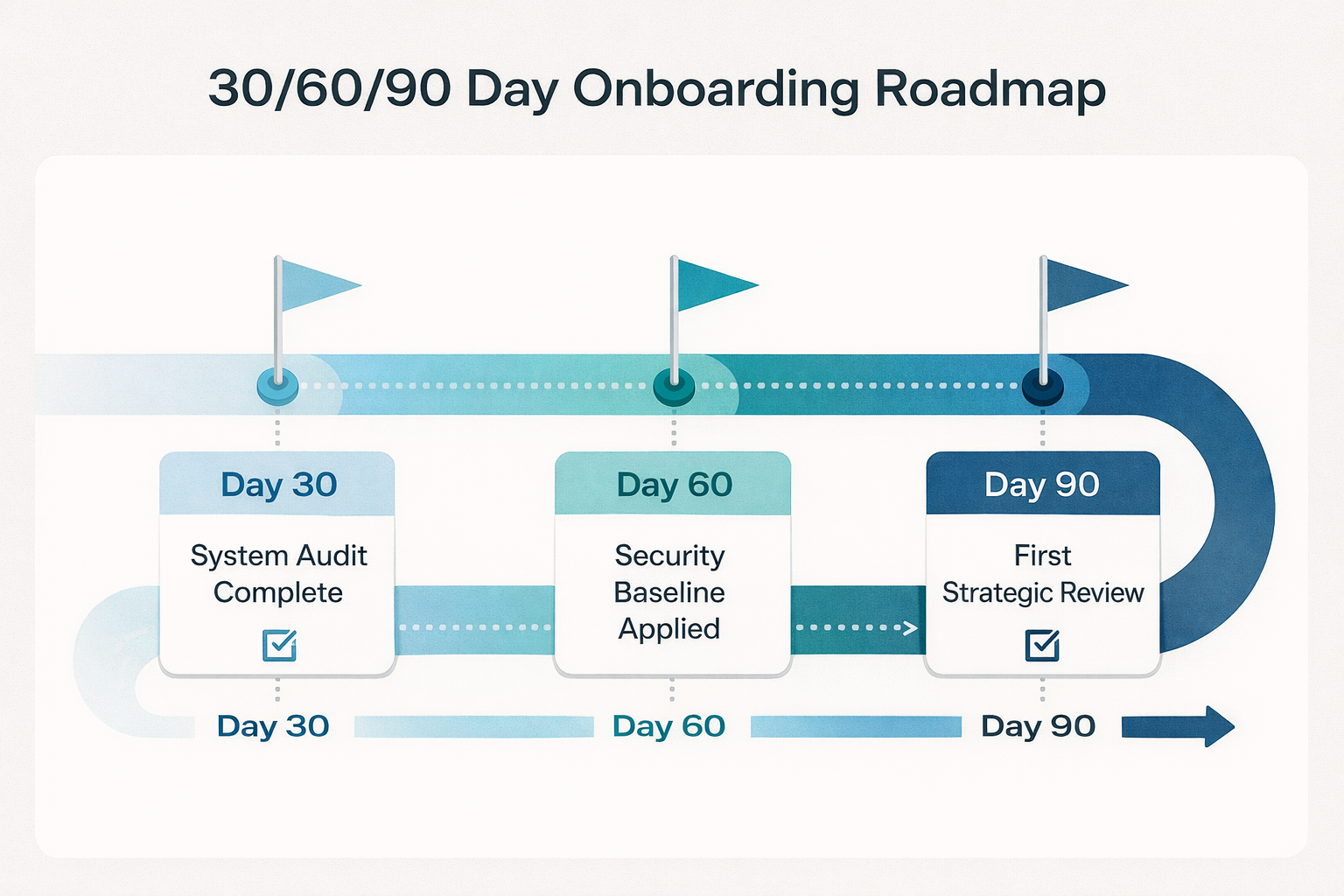
Customer success starts the moment a client signs, not when the first ticket arrives. Great MSPs treat onboarding like a project with clear outcomes, not a loose list of “things to set up.” The goal is to remove uncertainty: the client should know what the first 30, 60, and 90 days look like, who is responsible for what, and how success will be measured at each stage.
Industry insights from Rev.io on Growing MSP Businesses emphasize that improved onboarding processes are critical for connecting growth to consultative engagement. A solid MSP onboarding framework includes:
A welcome phase (introductions, expectations, communication norms).
Discovery and documentation (systems, processes, priorities, constraints).
Technical transition (access, agents, security baselines, monitoring).
Workflow and user change (how work will change day to day).
A first success milestone the client can actually feel.
This approach mirrors the mindset shift described in SinglePoint’s guide on the Transition from Break-Fix to MSP, where the focus moves from event-driven setups to relationship-driven peace of mind. With Prioriwise.ai, you can turn this into a reusable playbook: a workspace template with tasks, checklists, owner fields, and embedded documentation. Your team clones it for each new client, runs it asynchronously, and keeps every step visible to both internal staff and, where appropriate, the client.
Ongoing Health Monitoring That Goes Beyond Tickets
Tickets alone are a lagging indicator. By the time issues show up heavily in your PSA, user trust may already be eroding. An integrated customer success framework pulls in a broader view of client health, combining technical and human signals so you can intervene early.
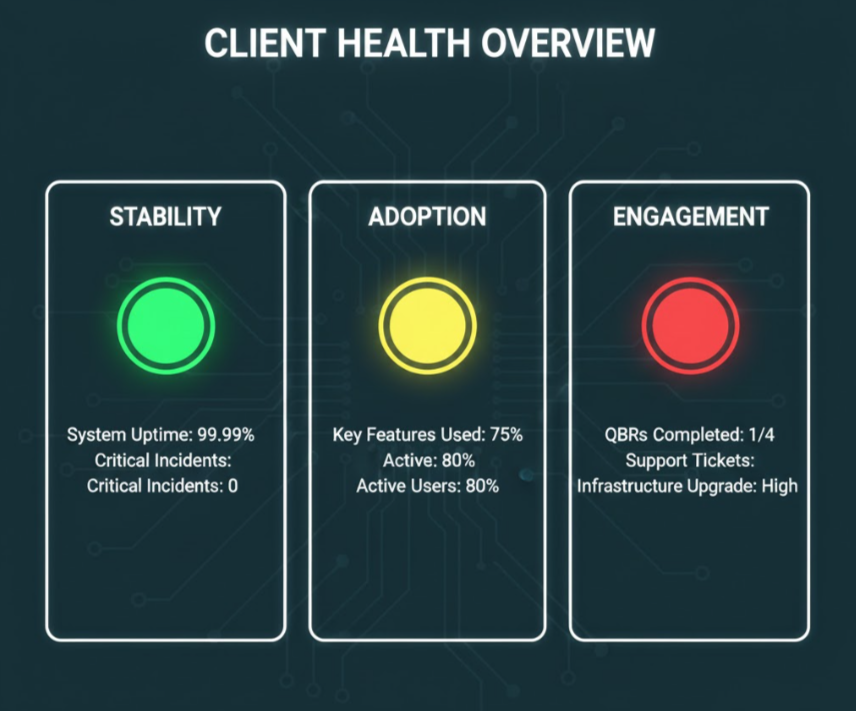
Useful health dimensions for MSPs include:
Support load and patterns: Volume, recurrence, and who is affected.
Environment stability: Alerts, failures, and security incidents.
Adoption of key tools: License utilization, login frequency, and feature usage where available.
Engagement signals: Response to check-ins, meeting cadence, and stakeholder sentiment.
This data-driven approach is supported by the State of Customer Success 2025 report from TSIA, which notes that effective teams rely on health scores and time-to-value metrics to communicate impact. Similarly, Custify’s Customer Success Statistics highlight how outcome-oriented KPIs are essential for proving value. Prioriwise.ai helps here by giving you structured threads for ongoing notes, risk flags, and decisions. Instead of burying insights in email or chat, your team logs what they are seeing in a shared client workspace. Over time, that becomes a living health narrative that any team member can scan before talking to the customer.
Making Business Reviews Strategic, Not Performative
Quarterly or semi-annual business reviews are where MSPs either cement their value or reveal that they have only been “keeping the lights on.” In a customer-success-driven framework, QBRs are not status meetings — they are strategy checkpoints built on a clear storyline.
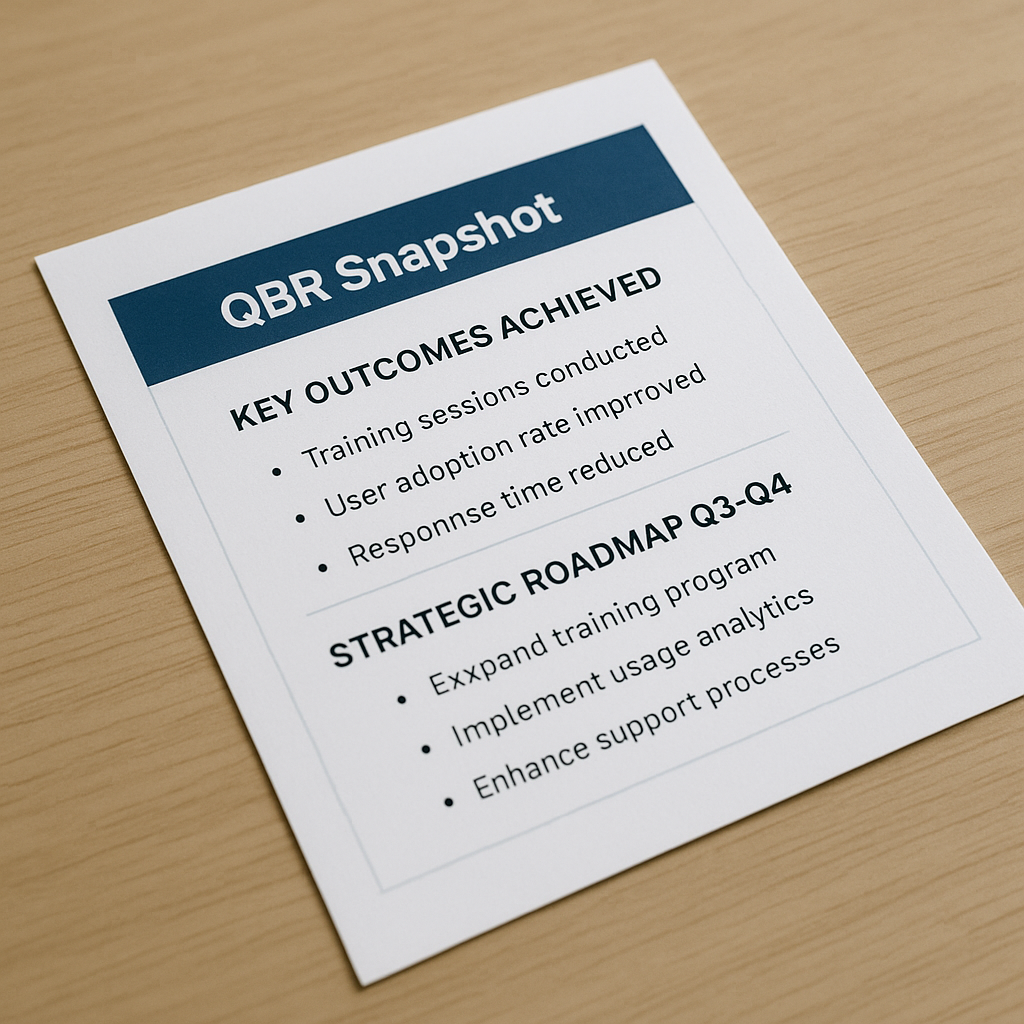
According to DeskDay’s analysis of the Rise of MSP 3.0, these reviews must shift the conversation from “What technology do you need?” to “What outcome are you after?”, functioning as strategic business enablers. A strong QBR storyline includes:
Where the client was when you started (baseline).
What has been delivered and improved since (outcomes).
Where the environment and business are heading next (roadmap).
This alignment is further supported by the TSIA State of Managed Services 2025 eBook, which discusses the necessity of value-based pricing tied to business outcomes. The most effective MSPs prep much of this asynchronously. They share written summaries, metrics, and recommendations ahead of time so meetings focus on decisions and alignment, not reading slides aloud. Prioriwise.ai’s async-first workspaces are ideal for this: you maintain a “Client Review” section with running notes, previous decisions, charts, and next-step proposals that stakeholders can review on their own schedule.
Building Adoption and Enablement Into Your DNA
Adoption is where most MSPs quietly win or lose the value story. You can configure the best stack in the world, but if teams do not adopt new tools and workflows, the client experiences little improvement — and may blame you for “overcomplicating” things. The 2025 MSP Business Trends Report by ScalePad frames client outcomes and adoption as the evolving "north star" for MSP success.
Your framework needs explicit adoption motions:
Training mapped by persona (leaders, managers, front-line users).
Simple, searchable SOPs and how-to guides tailored to their setup.
Short feedback loops to catch confusion early.
Periodic “tune-up” sessions focused on optimization, not firefighting.
Prioriwise.ai becomes your central hub for this enablement layer. You host client-specific guides, walkthroughs, and process docs in a shared workspace; link them directly to workflows; and keep versions updated as things change. Instead of sending attachments or one-off videos that vanish into inboxes, you give clients a single place to find “here is how we work now.”
Proactive, Async Communication as the Glue
Without a communication strategy, even a well-designed framework can feel chaotic. Too many MSPs rely on a mix of emails, chat threads, and impromptu calls to keep clients updated. Information gets lost, stakeholders get left out, and no one has a single source of truth.
An integrated framework defines:
What gets communicated, to whom, and how often.
Which updates can be async (status, progress, decisions) and which warrant a call.
Where documentation, decisions, and context are stored long-term.
Prioriwise.ai is tuned for exactly this necessity. Instead of spinning up another meeting, your team posts structured async updates inside the client workspace: what changed, why it matters, and what is next. Clients can comment, ask questions, or escalate to a call when needed — but the default is clear, written alignment, not calendar overload.
Turning Customer Success Into a Scalable Engine
The real power of an integrated customer success framework is that it scales. Once your onboarding, health monitoring, reviews, adoption, and communication motions are defined, you can apply them consistently across all clients, not just your largest ones. This consistency helps onboard new team members faster and allows you to spot patterns across the portfolio.
As noted in Forbes regarding the Future of MSPs in 2025, proactive providers that tie work to business outcomes are consistently outperforming reactive peers. Furthermore, Bering McKinley’s Strategies to Drive MSP Business Growth emphasize that long-term client value is built through this exact type of proactive partnership.
Prioriwise.ai acts as the backbone for this scale. It gives you:
Reusable playbooks for each stage of the customer lifecycle.
Structured workspaces where account history, decisions, and outcomes live.
Async collaboration so teams can execute without constant meetings.
With that foundation, customer success stops being a heroic, person-dependent effort and becomes a reliable, repeatable engine for retention and growth.
Ready to stop reacting and start predicting?
See how Prioriwise turns your delivery data into a live Relationship Health Score for every client.
Get Started